
19/08/2026
One imbalance after another
Newsletter #94 - August 2026
Japan and the weak yen
The Japanese yen is about as weak as it has been in decades - weak enough that the US Treasury has had to step in and help the Bank of Japan support it. That alone should give us pause. Why should the currency of one of the world's largest creditor nations need defending at all?
On the surface, it should not. Japan's current account is running a surplus of almost 5% of GDP. That is hardly the profile of a country whose currency is under attack, so surely the exchange rate cannot be the problem?
Yes and no. The headline current-account surplus hides the real issue: Japan's trade balance in goods and services has quietly swung into deficit.
Figure 1 — Japan: current account vs trade balance, % of GDP.
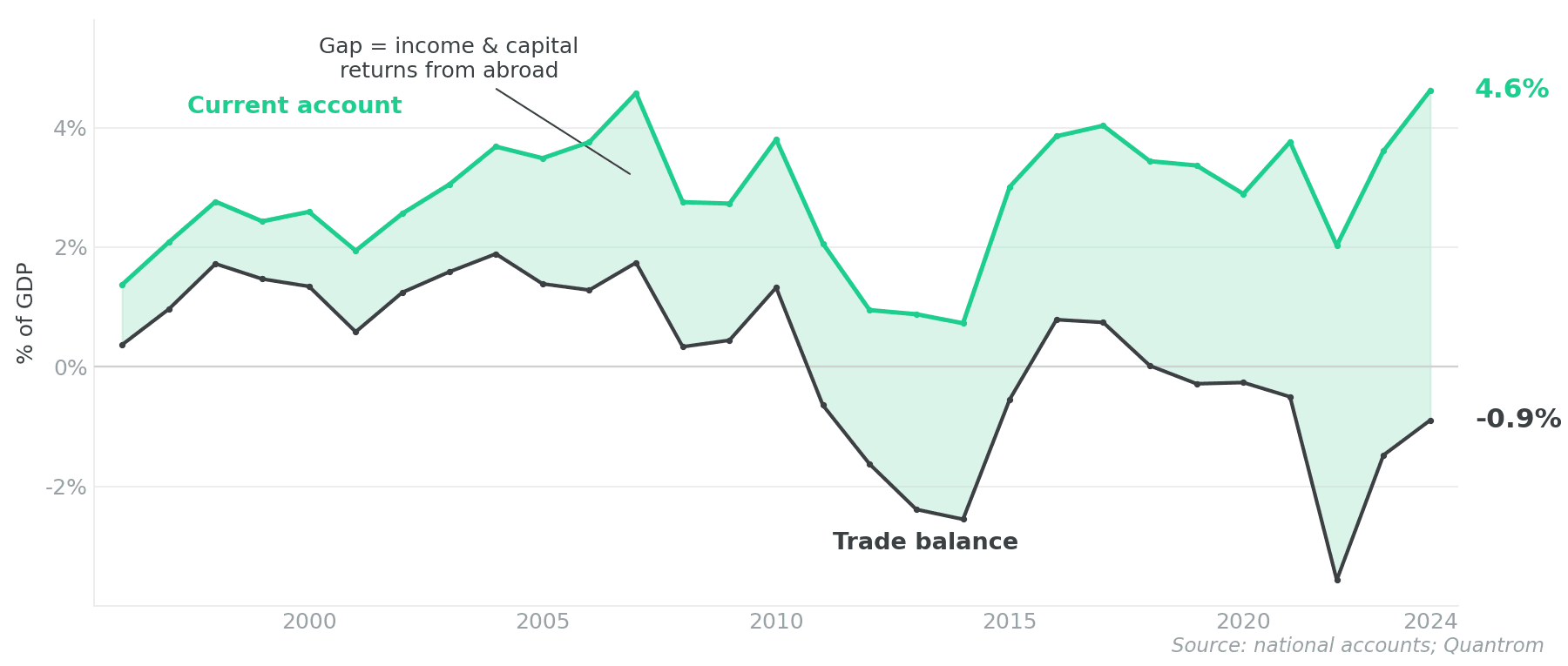
The gap between the two lines is the story. Japan still earns a sizeable surplus, but it now comes almost entirely from the income and capital returns on the assets it owns abroad rather than from trade. Strip those returns out and the country is running a goods-and-services deficit.
This is not the only imbalance on the books, and none of them are new. For years, Japan has lived with another one we all know well: a private sector running a large surplus while the public sector runs an equally large deficit.
And, almost by tradition, the policy mix has been wrong. In its long campaign to get inflation going, the Bank of Japan held interest rates near zero for decades. One of the many side effects was the yen carry trade i.e. borrow cheaply in yen and put the money to work in higher-yielding assets elsewhere.
That same logic has worked handsomely for Japanese companies. Borrow cheap at home, then buy businesses and assets outside Japan.
As we have examined before in this Newsletter, the current account ultimately has to balance, and that is what drives the underlying FX flow. Leaving tax considerations to one side, a major Japanese company that has spent years building a portfolio of foreign investments has no incentive to repatriate the money (sell foreign currency and buy yen) for as long as it expects the yen to keep weakening. It reports in yen, and simply leaving those assets abroad makes the numbers look better every quarter.
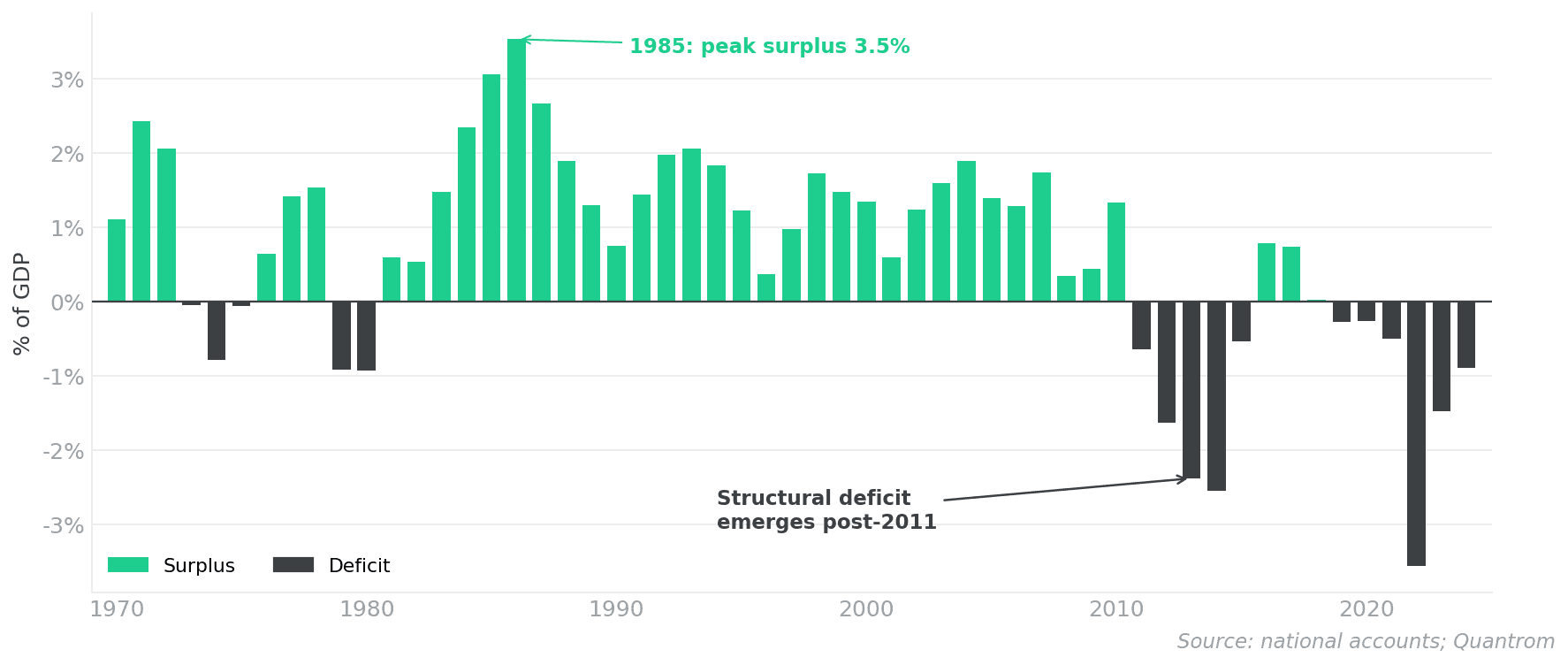
So, the current account shows a large surplus, flattered by capital and income gains, even while goods and services run a deficit. Seen over the long run, the shift on the trade side is unmistakable.
Figure 2 — Japan trade balance in goods and services, % of GDP, 1970–2024 (source: national accounts; Quantrom).
There is a hard constraint underneath all of this.
Japan still needs dollars to pay for the oil and gas it imports. The Bank of Japan has to lean on its reserves (more than a trillion dollars, much of it held in US Treasuries) to defend the yen and stop imported inflation from getting too far out of control.
Back to the imbalance in the US
On the other side of the trade, the US Treasury is in no hurry to shrink its budget deficit or balance its books, and so, conveniently, it does not want the Bank of Japan selling its Treasuries to fund a yen defence. Each side's imbalance quietly depends on the other's holding together.
It is worth pausing here to consider a warning that Thomas Hoenig, the former president of the Federal Reserve Bank of Kansas City, has just set out plainly: is US economic dominance now at risk? On the surface, the American economy looks anything but fragile. Growth is running near 2%, business investment is expanding at close to 8% on the back of the AI boom, jobless claims sit at historic lows and Washington is spending some $8 trillion this year. But, as Hoenig argues, much of that strength rests on expansionary fiscal policy and a still-too-accommodative Fed, which is precisely where the imbalance lies.
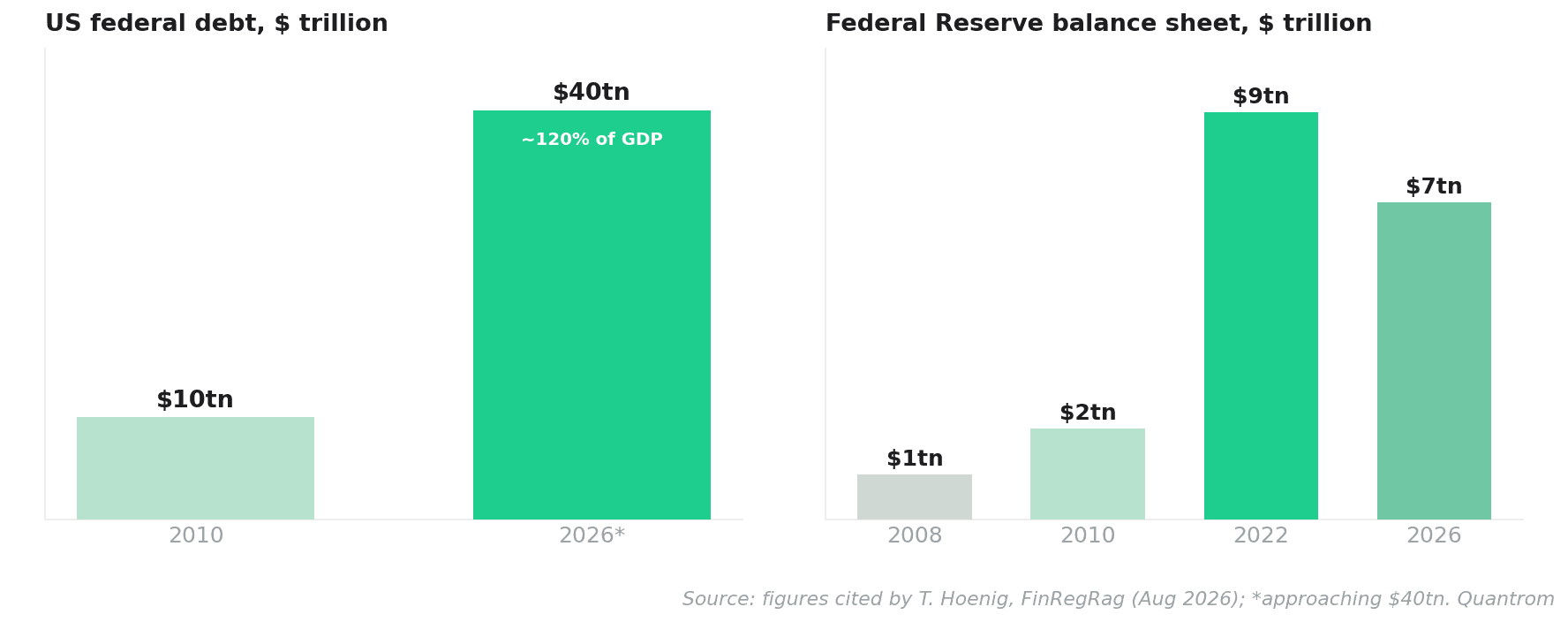
The fiscal numbers tell the story. After the financial crisis, the federal deficit reached nearly 10% of GDP in 2010, then peaked around 14.5% during the pandemic. Those emergency deficits were meant to fade as the economy recovered; instead, they have continued. Federal spending now runs at about 23% of GDP against revenues of only 17%, leaving large deficits even with the economy near full employment. Total federal debt, around $10 trillion in 2010, is now approaching $40 trillion - close to 120% of GDP.
The Federal Reserve has been the quiet enabler. As the Treasury issued record amounts of debt after 2008, and again after 2020, the Fed bought it in size through quantitative easing, holding down interest rates which would otherwise have risen as government borrowing pulled funds from the private sector. Its balance sheet swelled from roughly $2 trillion in 2010 to almost $9 trillion at the 2022 peak, and still sits near $7 trillion, which is about seven times its pre-2008 size. Stabilising markets in a crisis is one thing; keeping the balance sheet this large for this long, in Hoenig's telling, shades into monetising the government's deficits.
Figure 3 — US federal debt and the Federal Reserve balance sheet (source: figures cited by T. Hoenig, FinRegRag, Aug 2026; Quantrom).
The bill shows up as inflation, firstly in assets, then prices. US home prices are up more than 35% since early 2021 and consumer prices more than 27% over five years, while real wages have barely moved. The winners are those who already owned homes and equities; the losers are younger and first-time buyers priced out of both. That widening gap, Hoenig notes, erodes trust in institutions and sharpens the political tensions around them.
This leaves the Fed with an uncomfortable choice. Chairman Kevin Warsh has said that restoring 2% inflation and rethinking QE are priorities, which are commendable aims, but ones that depend on the Fed refusing to keep financing Congress's deficits. Keep monetising, and inflation persists; stop, and the private market must absorb the debt itself, pushing rates higher and raising the risk of recession. The only durable way out, Hoenig argues, is for Congress to confront the debt directly.
And beneath it all sits the dollar. Its role as the world's reserve currency is safe for now, but, as Hoenig puts it, reserve status is not a birthright, but rests on the strength of the economy and the credibility of American institutions. Persistent deficits, prolonged monetary accommodation and stubborn inflation chip away at that confidence, slowly at first then all at once.
The same fault lines in Europe
The pattern does not stop at the water's edge of the Atlantic. Europe carries its own version of every imbalance discussed above, and it offers the clearest historical reminder that reserve status, once lost, is irrevocable.
Start with the euro area, where monetary union has removed the exchange rate as a valve between members. Germany has run large and persistent current-account surpluses for two decades; while much of the periphery ran mirror-image deficits. Because there is no Deutsche Mark to rise and no lira or peseta to fall, that imbalance cannot be settled through the currency. It accumulates instead inside the plumbing of the system, as claims and liabilities between national central banks in the Eurosystem. The current account still has to balance; in a single-currency bloc it simply does so out of sight, rather than through the FX market.
The private-surplus, public-deficit split we noted in Japan is on display here too, most acutely in France, whose fiscal deficit and debt path we examined last autumn. France is running a deficit above 5% of GDP with public debt beyond 110%, and the European Central Bank, like the Bank of Japan, now finds itself caught between the inflation problem we set out in June's Newsletter and the fiscal reality of its most indebted members. Monetary policy cannot solve the problems of structural deficits in the public sector.
The United Kingdom shows the same tensions with the exchange rate switched back on. Outside the euro, sterling has always floated, and so it, rather than the payments system, absorbs the adjustment. Britain runs a persistent current-account deficit and depends, in Mark Carney's memorable phrase, on “the kindness of strangers” to fund it.
The gilt market we described in May as a canary in the coal mine is where that dependence is priced
Which brings us to the sharpest reminder of all. For the best part of a century, sterling, not the dollar, was the world's pre-eminent reserve currency: the currency of trade invoicing, of central-bank reserves, of the gold standard centred on London. Even in the aftermath of the Second World War, it still accounted for more than 80% of global foreign-exchange reserves. It was only in the mid-1950s, roughly a decade after the war and after a 30% devaluation of the pound, that the dollar's share finally overtook it. By the mid-1970s, sterling had fallen below 10% (Eichengreen and co-authors, 2018; Schenk, 2010). Its status endured on borrowed time, propped up by exchange controls and the sterling area, long after the economic fundamentals had turned.
The lesson is not that the dollar is about to be dethroned (it is not), buts that reserve status can persist well past the point the fundamentals justify, until the day it does not.
Hoenig's warning that reserve currency is no birthright is a lesson Britain already learned the hard way.
What lies ahead
The picture rhymes wherever one looks.
Japan is the most advanced case - a central bank boxed in by the fiscal choices made around it, spending reserves to defend a currency its own policy mix helped weaken. The United States and the UK are earlier in the same story but travelling in a familiar direction, and the euro area sits with its internal imbalances managed out of sight.
One imbalance after another, in Tokyo, in Washington and across Europe, and the same quiet question beneath all of them: what happens on the day one of the parties decides it no longer wants to play its part?
